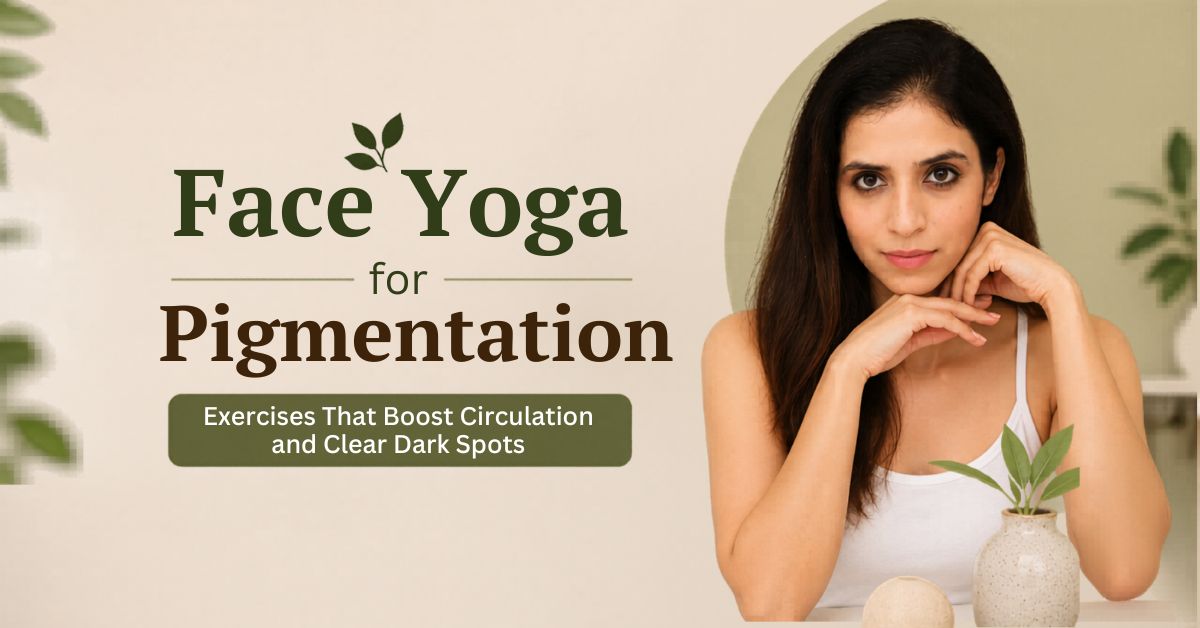
Face Yoga for Pigmentation — Exercises That Boost Circulation and Clear Dark Spots
- Face yoga improves blood circulation to the facial skin, increasing the delivery of oxygen and nutrients while clearing toxins that drive pigmentation.
- Lymphatic drainage through facial movement reduces the toxic load in facial tissues — one of the direct causes of dullness and uneven tone.
- Kapol Dhauti (face purification), tapping massage, and specific breathing exercises are Mansi’s core recommendations for pigmentation specifically.
- These exercises take 10–15 minutes a day and produce visible changes in skin clarity when done consistently alongside internal and topical rituals.
- Face yoga is the physical layer of a complete pigmentation treatment approach — it amplifies the results of everything else.
Most pigmentation treatments are passive — you apply something, or you take something, and you wait. Face yoga is the active layer of the approach. It’s the part that gets the blood moving, the lymph flowing, and the skin’s own renewal systems working more efficiently.
Mansi Gulati includes specific facial practices in her pigmentation protocol because the physical dimension of skin health is real and measurable. Poor facial circulation means cells are receiving less oxygen and fewer nutrients. It also means metabolic waste — including the kind of oxidative debris that worsens pigmentation — is clearing more slowly.
The exercises in this blog are not about toning or lifting, though those are benefits. They are specifically chosen for their effect on circulation, lymphatic drainage, and the oxygenation of skin tissue. Used consistently as part of the complete internal and topical approach covered across this series, they close the loop on pigmentation treatment in a way that nothing else does.
Why Circulation Matters for Pigmentation
The skin is a living organ that depends entirely on the vascular system to function. Blood delivers oxygen, Vitamin C, antioxidants, and the nutrients that support collagen synthesis and melanin regulation. Blood also carries away carbon dioxide and metabolic waste products.
When facial circulation is poor — which happens with sedentary habits, chronic stress, or simply the natural reduction in skin microcirculation that comes with age — the delivery-and-clearance cycle slows down. Antioxidants that should be reaching the melanocytes to moderate their activity arrive in lower concentrations. Inflammatory cytokines and oxidative debris that should be cleared accumulate instead.
The result is skin that looks dull, uneven, and older than it is — and pigmentation that proves resistant to topical treatment because the underlying tissue environment is compromised.
Face yoga directly addresses this by physically stimulating blood flow to the facial tissues through movement, pressure, and breath. The science behind how face yoga works explains the mechanisms behind this in more depth.
The Lymphatic System and Skin Toxins
The lymphatic system runs alongside the vascular system and serves as the body’s waste-clearance network. Lymph fluid collects cellular debris, dead immune cells, excess proteins, and toxins from the tissue spaces and carries them to lymph nodes for processing and elimination.
Unlike blood, which has the heart to pump it, lymph has no central pump. It moves through the contraction of muscles and the pressure of movement. In the face, where there are few large muscles and limited movement in most daily activities, lymph can stagnate — creating what practitioners call lymphatic congestion. This shows up as puffiness, dullness, and a toxic load in the facial tissue that contributes directly to pigmentation.
The tapping and movement practices in face yoga are one of the most effective ways to stimulate facial lymphatic drainage without professional intervention. How to reduce facial bloating with face yoga explores this in detail, and many of the same practices are directly relevant for pigmentation.
Exercise 1 — Kapol Dhauti (Face Purification)
Kapol Dhauti is a traditional yogic cleansing practice adapted for the face. “Kapol” means cheek or face in Sanskrit; “Dhauti” means cleansing or purification. The practice works by using air pressure and gentle external touch to drive oxygen into the skin’s superficial layers and stimulate the capillary network beneath.
How to do it:
- Take a full breath and fill the mouth completely with air — puffing both cheeks out as much as comfortable.
- Hold the air in the mouth while gently pressing the fingertips of both hands against the cheeks, temples, and forehead. Use the pads of the fingers, not the tips.
- The pressure of the fingers against the air-filled face drives a mild circulation response in the tissue beneath the skin.
- Hold for 10–15 seconds, then release the air slowly through pursed lips.
- Repeat 5–6 times in a session.
This can also be done with a small amount of cool water held in the mouth instead of air — the weight of the water increases the pressure effect slightly. Many women find the water version more effective for circulation stimulation.
When to do it: Morning, before applying any topical treatment. The increased circulation from this practice means that whatever you apply to the skin immediately afterward — including the Mulethi mask or raw milk cleanser — is absorbed more effectively.
Exercise 2 — Tapping Massage
Tapping is exactly what it sounds like, but the technique matters. The goal is not random patting — it is a systematic, rhythmic stimulation of the lymphatic pathways that run just beneath the skin surface.
How to do it:
- Using the pads of the index and middle fingers, begin tapping lightly along the jawline, starting from the chin and moving outward toward the ears.
- Continue tapping from the corners of the mouth, moving along the cheeks toward the ears.
- Tap from the bridge of the nose outward along the cheekbones.
- Tap across the forehead from the centre outward toward the temples.
- Finish with light tapping at the temples and behind the ears — where several major lymph nodes sit. This is the drainage point; tapping here encourages the lymph collected during the practice to move onward toward clearance.
The whole sequence takes 3–4 minutes. The tapping pressure should be firm enough to create a slight warmth in the skin but never painful. Speed should be rhythmic and consistent — not too fast, not too slow.
Done consistently, this practice visibly reduces facial puffiness and dullness within 2–3 weeks. Women who do this daily often report that skin looks more awake and clearer in the morning, and that the effects compound over time.
Exercise 3 — Balloon Pose and Air Pulling
This exercise strengthens the buccinator muscles (the muscles of the cheeks) while simultaneously driving lymphatic movement through the lower face and stimulating the salivary glands.
How to do it:
- Fill the cheeks completely with air — the same starting position as Kapol Dhauti.
- Shift the air slowly and deliberately from the left cheek to the right cheek and back, as if moving it back and forth. Hold for 5 seconds on each side.
- Then try pulling the air upward — toward the upper lip and under the nose — by shifting the tongue and facial muscles.
- Release and repeat 5–6 times.
The movement of air against the inside of the cheeks creates a self-massage effect on the inner facial tissue, stimulating circulation from both inside and outside the skin simultaneously. This is particularly effective for the cheek area where melasma and hormonal pigmentation most commonly appears.
Exercise 4 — The “O” Pose
The “O” pose stretches and activates the orbicularis oris (the muscle surrounding the mouth), the zygomaticus (cheek), and the platysma (neck and lower face) muscles simultaneously. It creates a significant circulation response across the mid and lower face — the areas where most pigmentation concerns concentrate.
How to do it:
- Open the mouth as wide and as rounded as possible — forming a large, exaggerated “O” shape.
- While holding this position, direct your gaze upward toward the centre of the forehead — not rolling the eyes back, but creating a controlled upward focus with slightly raised eyebrows.
- Hold for 10–15 seconds, feeling the stretch across the cheeks and lower face.
- Release completely and repeat 5–6 times.
The combination of maximum muscle stretch and gaze elevation creates a circulation rush to the mid-face that leaves the skin visibly flushed and warm immediately after — this is exactly the oxygenated blood flow that skin needs for healthy tone. The flush is temporary but the underlying circulation benefit accumulates with regular practice.
Exercise 5 — Circular Finger Massage (Oxidative Stress Release)
This is the simplest of the five but one of the most consistently recommended by Mansi for daily practice. The circular massage technique stimulates the capillaries directly beneath the skin surface, releasing accumulated oxidative stress and improving lymphatic flow simultaneously.
How to do it:
- Apply a small amount of raw milk, aloe vera gel, or a few drops of cold-pressed oil (sesame or coconut) to the fingertips as a slip agent.
- Using the index and middle fingers, make small, slow, clockwise circles across the forehead, down the sides of the nose, across the cheeks, and along the jawline.
- Apply gentle but consistent pressure — enough to feel the skin move slightly against the underlying tissue.
- Spend 30 seconds on each zone. The full face takes 3–4 minutes.
- Finish with long outward strokes from the centre of the face toward the ears and down the neck — following the lymphatic drainage direction.
This is the ideal wind-down practice before bed. When done after the Manjistha water and before sleep, the improved circulation from the massage supports the liver and blood purification work that happens overnight.
Putting the Complete Protocol Together
Across this 10-blog series, Mansi’s complete approach to pigmentation has covered every layer:
- Internal: Amla ritual, Manjistha, turmeric, liver detox juice, sugar reduction
- Topical: Mulethi mask, Masoor Dal mask, raw milk cleansing, chemical break from synthetics
- Physical: Kapol Dhauti, tapping massage, Balloon pose, O pose, circular massage
Each layer addresses a different part of the problem. Internal rituals change the body’s chemistry. Topical masks inhibit melanin at the surface. Face yoga improves the tissue environment that both the internal and topical work are trying to support.
None of these layers works as well in isolation as all three do together. Facial yoga exercises for glowing skin and Mansi’s radiant skin routines offer more context on the broader practice if you want to go deeper.
If you want to experience this complete approach in a structured programme guided by Mansi directly, the Pigmentation Correction Challenge is where all of it comes together. The 14 Day Ultimate Glow Face Yoga Challenge is the ideal starting point if you want to build the physical practice first before going deeper into the full programme.
Frequently Asked Questions
Can face yoga actually reduce dark spots and pigmentation?
Yes, when understood correctly. Face yoga does not bleach or chemically alter melanin. What it does is improve blood circulation and lymphatic drainage in the facial tissue — delivering more oxygen and nutrients to melanocytes while clearing the inflammatory toxins that stimulate excess melanin production. Used consistently alongside internal and topical treatment, face yoga significantly accelerates and sustains the results that other approaches alone cannot maintain.
How long before face yoga produces visible skin changes?
Circulation and lymphatic changes are visible from the first session — flushed, brighter skin immediately after practice. Cumulative changes in tone, pigmentation, and texture develop over 3–6 weeks of daily or near-daily practice. The skin changes become more significant and lasting when face yoga is combined with internal and topical rituals rather than practised alone.
What is the best time of day to do face yoga for pigmentation?
Morning is the most effective time for Kapol Dhauti, tapping, and the Balloon and O poses — the circulation boost in the morning sets up better nutrient delivery for the whole day. Evening is the best time for the circular massage, particularly before bed alongside the Manjistha night ritual, to support the overnight liver and skin repair cycle.
Can face yoga cause wrinkles?
This is a common concern. The exercises Mansi teaches are specifically designed to work with the facial musculature and skin in ways that support rather than stress the tissue. Controlled, intentional movements — particularly those that stretch and activate rather than repetitively crumple the same area — do not cause wrinkles. Uncontrolled facial expressions and sun damage cause wrinkles. Face yoga, done correctly, actively reduces the factors that contribute to ageing skin. See also: face yoga exercises and their anti-ageing benefits.
How is Mansi’s face yoga approach different from general facial exercises?
Mansi’s approach integrates Ayurvedic principles — the connection between internal organ health, blood quality, and skin appearance — with the physical facial practice. The exercises are not isolated cosmetic movements; they are part of a complete system that addresses why the skin is showing what it is showing, not just what it looks like on the surface. This is what makes the results different in quality and in lasting power from generic facial fitness programmes.