
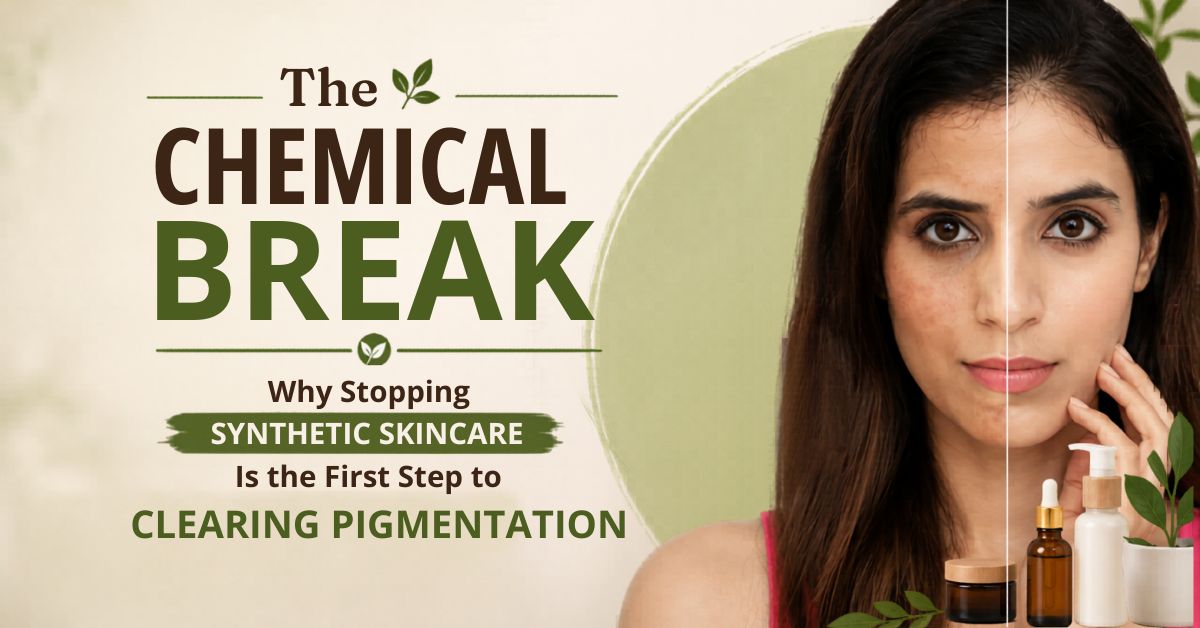
The Chemical Break — Why Stopping Synthetic Skincare Is the First Step to Clearing Pigmentation
- Years of synthetic skincare use accumulates oxidative stress and chemical sensitisation in the skin that worsens pigmentation.
- Many brightening serums and active ingredients create initial improvement followed by long-term dependency and skin barrier damage.
- A 21 to 30-day chemical break — stopping all synthetic face washes, serums, and actives — allows the skin barrier to repair and reset.
- The transition period (first 7–10 days) can feel worse before it gets better. This is expected and temporary.
- Natural alternatives (raw milk cleanser, Mulethi mask, aloe vera gel) provide gentle care during the break without disrupting recovery.
If you are using 4 or 5 skincare products every day and your skin is still not improving — or is slowly getting worse — the products might be part of the problem.
This is not a common message in the skincare industry, for obvious reasons. But it is something Mansi Gulati sees regularly in women who come to her frustrated after months or years of trying different combinations of serums, toners, actives, and brighteners without lasting results.
The skin is not a passive surface that absorbs whatever is applied to it without consequence. It’s a living organ with its own microbiome, barrier function, and repair systems. Disrupting those systems with a constant rotating cycle of synthetic actives, preservatives, and chemical agents creates a form of chronic stress that both worsens pigmentation directly and prevents it from healing.
How Synthetic Skincare Can Worsen Pigmentation
Several mechanisms are at work here.
Disruption of the skin microbiome: The skin surface hosts a community of beneficial bacteria that contribute to barrier function, pH regulation, and protection against pathogens. Most synthetic cleansers, particularly those with sulfates, antibacterial agents, and preservatives, disrupt this microbiome. The result is a compromised skin barrier — more prone to inflammation, more reactive, and less capable of self-repair. Chronic barrier disruption is a direct trigger of Post-Inflammatory Hyperpigmentation.
Chemical sensitisation and reactive inflammation: Many women cycling through multiple active ingredients — retinoids, AHAs, BHAs, hydroquinone, kojic acid, arbutin — develop sensitised skin over time. Sensitised skin is skin that reacts to a wide range of stimuli with inflammation. And inflammation, as covered in the root causes of pigmentation, directly stimulates melanin. The treatment itself becomes a trigger for the problem it’s supposed to solve.
Oxidative stress accumulation: Many synthetic ingredients — particularly unstable Vitamin C derivatives, alcohol-based formulas, and fragrance compounds — generate reactive oxygen species in the skin. These free radicals cause cellular damage and melanin stimulation. The skin’s antioxidant defence systems can be overwhelmed by daily exposure to these compounds, particularly in women who are also dealing with blue light exposure, dietary oxidative stress, and internal liver load simultaneously.
Dependency and rebound: Some active ingredients suppress melanin production while they’re being applied, but as soon as they are stopped, melanin rebounds — often faster and more intensely than before the treatment started. This creates a cycle where women feel they cannot stop using the product, even as their skin becomes progressively more sensitised and reactive.
What a Chemical Break Actually Involves
Mansi recommends a minimum of 21 days, ideally 30 days, completely off all synthetic skincare. This means:
- No synthetic face wash or cleanser
- No toner, essence, or mist with synthetic ingredients
- No serums of any kind (Vitamin C, retinol, niacinamide, acids)
- No synthetic moisturiser
- No chemical sunscreen (mineral-only SPF if sun protection is needed)
- No makeup that sits on the skin for extended periods, if possible
This is the stripping-back of the skin to its basic state, giving it a chance to rebalance its own microbiome, repair its barrier, and clear the accumulated chemical sensitisation.
The First Week — What to Expect
The first week of a chemical break is often uncomfortable, and it’s important to know this in advance. The skin that has been relying on synthetic ingredients to suppress oil production, manage bacteria, and regulate hydration suddenly has to do all of this on its own again. For some women, there is an initial flare — breakouts, increased oiliness, mild redness, or dryness.
This is not the skin rejecting the break. It is the skin recalibrating. The microbiome is reestablishing. The barrier is beginning to repair. This phase typically lasts 5–10 days and resolves on its own as long as the break continues.
Stopping the break during this phase — going back to the synthetic products because the skin got temporarily worse — restarts the damage cycle without allowing the repair to complete. The transition discomfort is the cost of the reset. Most women who push through it report that skin stabilises noticeably from day 10 onwards.
What to Use During the Break
The chemical break is not a “no skincare” break — it is a synthetic skincare break. Natural alternatives that support the skin without disrupting its recovery:
Cleansing with raw milk: Chilled raw milk applied with a cotton pad and wiped off cleanses the skin gently, removes surface dirt and makeup, and provides lactic acid in tiny natural concentrations that support skin renewal without the irritation of synthetic AHAs. Used consistently for 7 days, most women notice a visible brightening effect. Mansi recommends this as the primary cleanser throughout the break — and many women continue it permanently afterward.
Mulethi and rose water: Mulethi (licorice root) powder mixed with rose water to a paste consistency makes a simple, powerful topical treatment. Mulethi is one of the most well-studied natural tyrosinase inhibitors — it reduces melanin synthesis with effectiveness comparable to kojic acid but without the irritation. Rose water soothes barrier inflammation and provides mild antioxidant protection. This combination supports the skin gently through the break and begins actively treating the pigmentation. The full range of natural masks for pigmentation is covered in the natural masks blog.
Fresh aloe vera gel: Applied as a light moisturiser over the face after cleansing. Aloe vera hydrates, soothes inflammation, and contains acemannan — a polysaccharide that supports skin barrier repair. It’s one of the few topicals that actively supports recovery during the reset phase without introducing any chemical load.
Mineral SPF: If sun protection cannot be avoided — particularly for women with active melasma or outdoor exposure — a clean mineral sunscreen (zinc oxide or titanium dioxide, no synthetic UV filters, no fragrance, no alcohol) is the only exception to the break. Apply only what is necessary and remove it at the end of the day with raw milk rather than a synthetic cleanser.
What Comes After the Break
After 21–30 days, most women notice skin that is calmer, less reactive, and visibly more even in tone than it was before the break. Dark spots that were inflamed or recent are often lighter. The skin looks less processed and more genuinely healthy.
Reintroducing products after the break should be slow and deliberate — one product at a time, allowing a week between introductions to isolate any reactions. This is also an opportunity to reassess which products are actually necessary and which were part of a habitual routine rather than a genuine skin need.
Many women who complete the break find they need far fewer products than before. The combination of natural cleansing, the Mulethi and Masoor Dal masks covered in the natural masks for pigmentation blog, and the internal rituals covered throughout this series is often sufficient for ongoing skin health without returning to a complex synthetic routine.
For a structured programme that guides you through the chemical break alongside internal rituals and face yoga, Mansi’s Pigmentation Correction Challenge is the most complete version of this approach in one place.
Frequently Asked Questions
What if my skin gets worse during the chemical break?
A temporary worsening in the first 5–10 days is expected and is part of the skin recalibration process. The microbiome is rebalancing and the barrier is beginning to repair. This phase passes on its own if the break continues. Going back to synthetic products during this phase restarts the damage cycle without allowing recovery to complete.
Can I wear sunscreen during a chemical break?
Yes, but only a clean mineral SPF — zinc oxide or titanium dioxide base, no synthetic UV filters, no alcohol, no fragrance. Apply only the necessary amount and remove it with raw milk cleanser at the end of the day rather than a synthetic cleanser.
Can I wear makeup during the chemical break?
Ideally, reduce makeup to the minimum possible during the break — particularly products that sit on the skin for extended periods. If makeup is unavoidable, opt for mineral-based formulations and remove them fully at the end of each day using raw milk or a gentle oil cleanse.
Will I lose all my skincare progress if I do a chemical break?
No. Results from years of synthetic skincare do not disappear in 21–30 days. What the break does is allow the skin barrier to stabilise and the microbiome to rebalance, which then makes any subsequent treatment — natural or synthetic — significantly more effective. Most women find their skin is in a better starting position after the break than before it.
Is a chemical break safe for sensitive skin?
It is particularly beneficial for sensitised skin, which is often sensitive precisely because of chronic synthetic ingredient overuse. The raw milk, aloe vera, and Mulethi approach recommended during the break is gentle enough for the most reactive skin types. If you have a specific diagnosed skin condition — rosacea, eczema, psoriasis — consult your dermatologist before stopping any prescribed topical treatments.