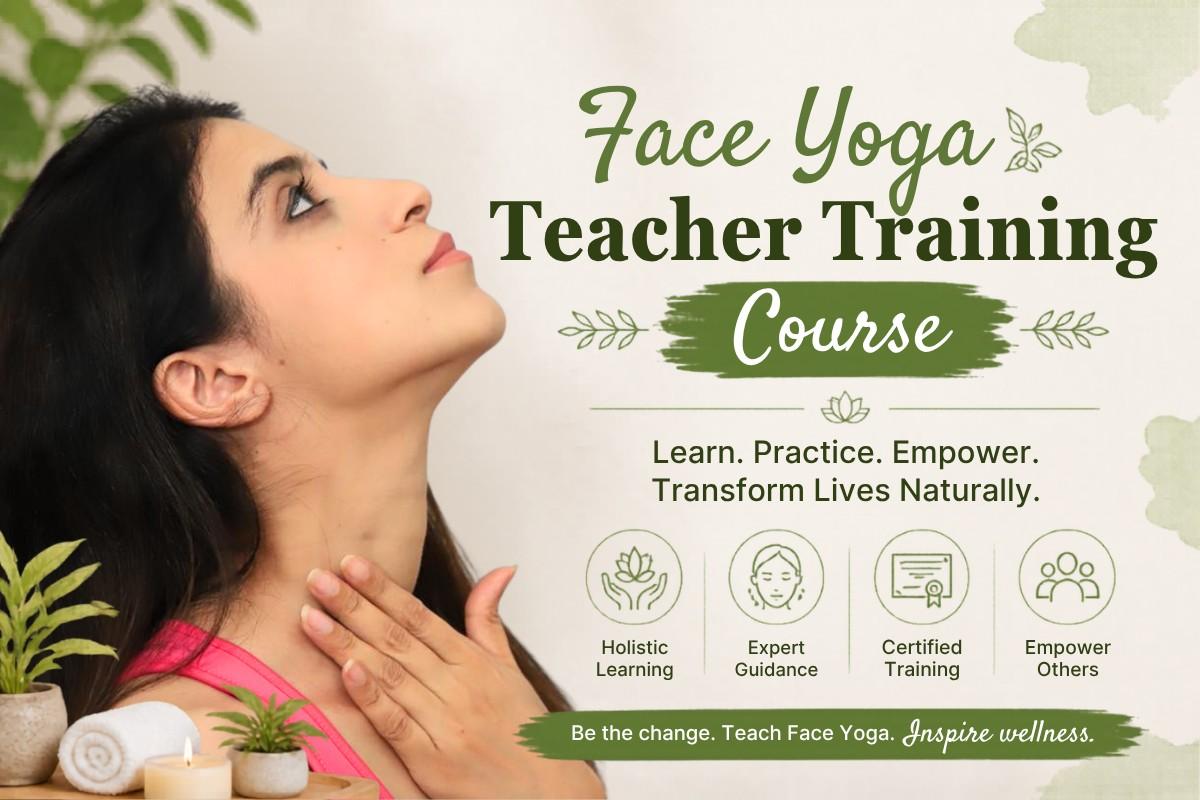
Face Yoga Teacher Training Course: What You Actually Learn, What It Costs, and Whether It’s Worth It
A face yoga teacher training course qualifies you to teach facial exercises, massage techniques, breathwork, and facial anatomy to clients. In India right now, you can spend anywhere from ₹4,000 on a weekend crash course to ₹40,000+ on a full live certification. That’s a wide range — and the gap between them isn’t just cost. It’s depth, support, and whether you’ll actually be able to teach at the end of it.
I’ve been running my own teacher training for several years now. The pattern I keep seeing: someone picks a course based on what fits their budget that month, completes it, and then six months later messages me saying they don’t feel confident enough to take on clients. Not because they weren’t capable — because the course didn’t go deep enough. This guide is meant to help you think through the decision before you pay.
What a face yoga teacher training course actually covers
Most programmes cover the same topics on paper. Where they differ is how far they go into each one.
The non-negotiables — what any solid face yoga TTC should give you:
- Facial anatomy and muscle function — not just names, but which muscles create expression lines, which ones lose volume with age, and why the same exercise produces different results depending on someone’s starting point
- Face yoga exercises — the full library: forehead, eye area, cheeks, jawline, lips, neck — with correct technique, hold times, and what to avoid in specific conditions
- Massage and acupressure — lymphatic drainage, facial sculpting strokes, marma point work
- Breathwork and pranayama — specifically how breath affects skin oxygenation and facial muscle tension, not just general pranayama
- Skin science — collagen, elastin, the structural layers, how aging changes each one
- Class design — how to structure a 30, 45, or 60-minute session for different client types and goals
- Client consultation — intake, contraindications, adapting to different skin conditions and age groups
That’s what a good course covers. Advanced programmes go further — hormonal health and its effect on facial aging, nutrition for skin, and the business side of building an actual teaching practice. That last part matters more than most people realise when they’re enrolling.
What to check before enrolling in any face yoga certification course
There are now dozens of face yoga certifications available in India, at every price point. Most of their marketing says the same things. Here’s what I’d actually look at:
How many live hours does it include?
A 2-day intensive will teach you something. It won’t teach you enough to handle real client questions with confidence. If you plan to teach professionally — even part-time — look for 30+ hours of structured live content. The depth you can offer clients is roughly proportional to the depth you were trained to.
Who is actually teaching it?
This one gets skipped constantly. Face yoga in India is young enough that some certification courses are run by people who themselves certified two years ago from a short online course. Ask how long the instructor has been practising. Ask who they trained under. A ten-year teaching history is verifiable — social media following isn’t.
Does anatomy come included, or is it an add-on?
Anatomy is what lets you explain why something works, not just demonstrate that it does. It’s also what lets you safely work with clients who have had Botox, fillers, TMJ issues, or any surgical history. A certification that skips anatomy leaves a gap that clients will eventually find — usually mid-session, when someone asks you something you can’t answer.
What happens after you finish?
The certificate isn’t the hard part. What comes after it is. Ask what the course gives you to actually start teaching: session scripts, workshop formats, consultation templates, anything. Ask whether there’s mentorship or a community after certification ends. Several of my students came to me specifically because they’d completed cheaper certifications elsewhere and had no idea how to translate them into an actual client base.
What does the certificate actually say?
Some certifications have Yoga Certification Board (Ministry of AYUSH) affiliation. Others are independent. Neither is automatically better — plenty of rigorous independent programmes outperform affiliated ones in content depth. What matters is whether the credential means something to the kind of clients you want to work with. A wellness professional serving corporate clients will need a different kind of credibility than someone teaching community workshops in Hyderabad.
Face yoga teacher training cost in India — what to expect
| Course Type | Duration | Typical Cost (INR) | Best For |
|---|---|---|---|
| Weekend crash course | 2–3 days | ₹4,000–₹17,000 | Personal practice, basic awareness |
| Short online programme | 4–6 weeks | ₹7,000–₹20,000 | Wellness professionals adding a skill |
| Comprehensive live TTC | 40–50 hours | ₹30,000–₹40,000 | Serious practitioners, career changers |
| Advanced / dual certification | 50+ hours | ₹35,000–₹50,000 | Building a full wellness practice |
Something cost comparisons tend to miss: the materials and support built into a course have real monetary value on their own. Client consultation templates, workshop scripts, business mentorship — if you have to create all of that yourself after a cheaper certification, it costs you time you weren’t accounting for. A ₹35,000 course with those tools included may actually be cheaper over 12 months than a ₹7,000 course without them.
What Mansi Gulati’s face yoga teacher training course includes
My Advanced Face Yoga Teacher Training Certification runs as live morning sessions — 11 am to 12 pm IST — with the next batch starting 18 May 2026. Here’s what’s in it:
- Advanced Face Yoga Teacher Certification, Level 1 and 2
- Certified Hormone Wellness Coach Certification — I’ll be direct about why I added this. Hormonal changes after 35, through perimenopause and beyond, are one of the biggest drivers of visible facial aging in women. Collagen loss, skin texture changes, jawline shift — a lot of what clients come in asking about is connected to hormones, not just muscle tone. Most face yoga TTCs don’t go anywhere near this. Understanding it changes what you can offer and how specifically you can advise.
- Lifetime access to all recorded sessions
- Full course materials, guides, and nutrition plans for skin and hair
- Business mentorship — student acquisition, pricing, class format design
- Client consultation and handling training
- Ready-to-use class scripts and workshop formats
- Lifetime community access
Current price: ₹34,999 (reduced from ₹39,999). If you want to see how I teach before committing anything, the Free Face Yoga Masterclass takes 30 minutes and costs nothing.
Who is a face yoga TTC right for?
Wider than people expect. My batches aren’t mostly yoga teachers — they’re a mix, and the mix has shifted over the years.
Beauty therapists and aestheticians come in regularly now. They want something non-invasive and non-chemical to add alongside their existing treatments. Face yoga fits that gap well, especially as clients push back more on injectable schedules. Wellness coaches come in looking to add something tangible and results-visible to their practice. Yoga teachers come wanting a specialisation that’s genuinely different from what the next instructor down the road is offering.
The group that surprised me most when I started the TTC: women in their late 30s and 40s who found face yoga themselves, used it consistently, saw real changes, and thought — I want to teach this. They start with workshops for friends. Some of them build serious practices. A few have started their own online programmes within 18 months of certifying with me.
And there are career changers — people in IT, HR, corporate roles — looking for something portable, teachable online, and not tied to an office or an employer. Face yoga can be built part-time. The international student angle (US, UK, Canada) means the income ceiling in USD is meaningfully higher than teaching only in India.
If you’ve already gone deep on the science behind how face yoga works and want to take that into a qualification, this is the logical next step.
What does a face yoga teacher actually earn?
Honest answer: anyone quoting you a guaranteed monthly income figure is guessing or selling. The range is genuinely wide.
From what I’ve watched among my certified students — the ones who started teaching within 90 days and kept at it consistently — here’s what’s realistic:
- Private sessions in India: ₹500–₹2,000 per session, depending on city, experience, and how you’ve positioned yourself
- Group online classes (10–15 students): ₹300–₹500 per head, which adds up faster than private sessions once you’re running several per week
- Workshops (2–3 hours, 15–30 participants): ₹800–₹2,500 per participant — these are where newer teachers often make their first real money, because the one-time format is less intimidating to start
- International clients from the US or UK: pricing in USD at $40–$80 per hour is common and realistic once you’ve built any online presence at all
The thing that separates teachers who build something from those who don’t isn’t which certification they chose. It’s whether they started teaching before they felt ready. The ones waiting to feel fully prepared rarely start. The ones who taught their first group of five friends two weeks after certifying — those are the ones with practices a year later.
If you’re going to teach face yoga, your clients will ask about Botox. A lot of them are using it or considering it. Read the comparison of face yoga vs Botox so you can answer those questions with actual research behind you, not just an opinion.
Frequently asked questions about face yoga teacher training
What is a face yoga TTC?
TTC is short for Teacher Training Course. A face yoga TTC is a certification programme that trains you to teach facial exercises, massage, breathwork, and facial anatomy to clients. It can run anywhere from 2 days to 50+ hours. The duration matters: a weekend course gives you a starting vocabulary; a comprehensive live TTC gives you the depth to handle real client sessions, adapt to different conditions, and build something sustainable.
How long does a face yoga teacher training course take?
Weekend intensives: 2–3 days. Short online formats: 4–6 weeks of part-time sessions. Comprehensive live certifications like mine run for several weeks, totalling 40–50+ hours. What you put in determines what you can give clients. I’d be sceptical of any course promising full teaching readiness in under 20 hours — facial anatomy and client consultation work alone take longer than that to do properly.
What is the cost of a face yoga certification course in India?
Weekend crash courses: ₹4,000–₹17,000. Short online programmes: ₹7,000–₹20,000. Comprehensive live TTCs: ₹30,000–₹40,000. Advanced dual certifications (face yoga + a second discipline like hormone wellness coaching): ₹35,000–₹50,000. The cost itself doesn’t tell you much — what matters is hours of live content, what support exists after completion, and what materials you walk away with.
Can I do a face yoga certification course online in India?
Yes, and most good ones run online. My Advanced TTC is entirely online — live morning sessions on Zoom with lifetime access to recordings. The misconception is that online means lower quality. It doesn’t. What it does mean is you need to check whether the course has actual live interaction built in. Pre-recorded-only programmes are a different product and a weaker one.
Do I need prior yoga experience to enrol in a face yoga TTC?
No. Face yoga is its own discipline — it shares vocabulary with yoga but it’s not a branch of asana practice. Most of my certified students had no formal yoga teaching background before the TTC. What they had was genuine curiosity and a consistent personal practice. The course builds the anatomy and technique knowledge from scratch.
What is the best face yoga certification in India?
There’s no answer to this that holds true across all situations. What I’d look for: an instructor with a verifiable 5+ year practice history, 30+ hours of live content, facial anatomy explicitly in the curriculum, and post-certification support that actually exists. My Advanced TTC includes all of that plus hormone wellness coaching, which no other programme in India currently pairs with face yoga at this level. But evaluate any programme against those criteria, not just price.
Can I teach face yoga online after certification?
Yes, and most certified teachers do. Online removes the geographic constraint entirely. You can work with students in Bengaluru, Mumbai, London, and Toronto in the same week. The class scripts and workshop formats included in the certification are designed for online delivery — you don’t need to figure that format out from scratch.
What career can I build with a face yoga teacher certification?
Private sessions, group classes, workshops, corporate wellness programmes, retreats, and eventually your own online courses are the most common paths. Income varies — it depends on how quickly you start, how consistently you teach, and who you choose to serve. Niching down to a specific audience (women in perimenopause, post-Botox clients, beauty professionals looking to upskill) tends to build a practice faster than staying general.